

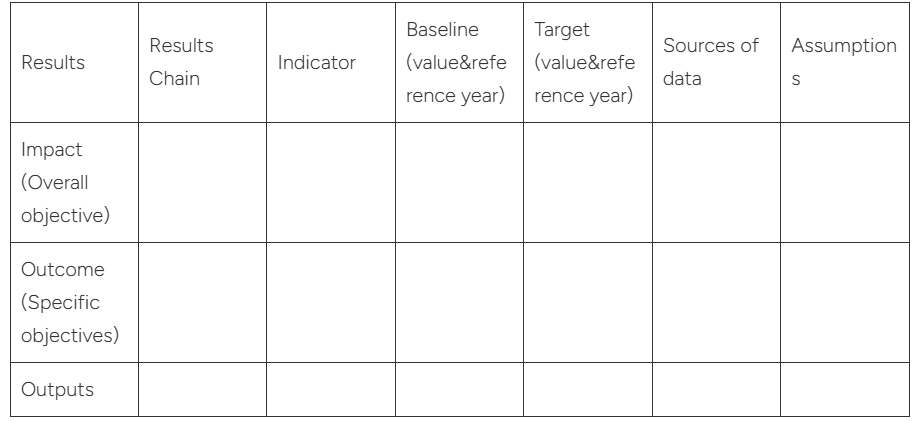
The logical framework illustrated below serves as the foundation for both nationally funded projects and those supported by the European Union, the United Nations, and other international organizations. Completing this framework is rarely a quick task; it requires information gathered through a series of analytical processes. Once the methodology behind these analyses is understood, the framework becomes much easier to develop and manage.
A common mistake in preparing a logical framework and project proposal is treating the “project idea” as if it were the “project objective.” Instead, the project idea must be established on a strong analytical foundation before being translated into objectives.
Project proposals that focus solely on the “idea” without building a solid foundation often fail to adequately address problems, meet the needs of target groups, or present a coherent and consistent project design.
Establishing a strong foundation is only possible through a thorough analytical process. Without careful analysis, determining the project’s objectives, outcomes, and activities is not feasible—just as effective budgeting and resource planning are impossible without a well-structured plan.
Thus, preparing a Logical Framework involves two fundamental stages: Analysis and Planning.
In the first stage, a stakeholder analysis is conducted, including an assessment of institutional capacity and the needs of vulnerable groups, and identifying potential stakeholders and their needs and capacities.
In the second stage, a core problem faced by stakeholders is selected, and the cause-and-effect relationships surrounding this problem are mapped.
Next, a target analysis is carried out to illustrate the positive outcomes that will result from resolving the identified problems.
Finally, by taking into account program priorities, institutional capacity, budget, and time constraints, the proposal’s focus, intended outcomes, and activities are defined using appropriate strategies.
After completing the analysis, the first column of the logical framework matrix—the results chain—can be generated, leaving most of the project application form ready for completion.
However, determining the project’s goals, outcomes, activities, and especially the assumptions (the final column of the matrix) can be challenging for many applicants.
Assumptions are external factors that can influence or determine a project’s success but lie outside the direct control of project managers. These are often linked to achieving higher-level results in the activity-outcome-goal hierarchy.
For example, when writing an assumption at the activity level, the correct question is not “What are our assumptions for carrying out these activities?” Instead, it should be: “What assumptions must hold true for us to achieve the desired results when all activities are carried out?”
Other columns in the matrix relate to performance indicators and means of verification (data sources). Performance indicators should be SMART—specific, measurable, achievable at a reasonable cost, relevant, and time-bound. Only with well-defined indicators can the achievement of project results and objectives be objectively demonstrated.
Additional key elements of the project include its budget, resource requirements, and duration. These are determined during the planning phase, following the analysis.
Total project duration is determined by considering the length, sequence, interrelationships, and dependencies among activities. Durations must be set realistically and appropriately, reflecting actual project conditions.
If you require support in preparing the logical framework for your project proposals, please contact us.
 ASTERA ACADEMY CONSULTANCY